
Science influences warfare when new knowledge becomes usable equipment, steady production, and sound military practice. The history of war shows that each step takes time, and invention alone does not ensure success.
Science has changed weapons, communications, transport, intelligence, and battlefield medicine. Military research and development can also create civilian uses, while new systems bring fresh risks. A dual-use technology is a technology developed for, or adapted to, both military and civilian purposes.
This overview explains the problems that pushed forces to change and the choices that shaped each result. It follows a path from basic materials and engineering to connected, increasingly automated systems.
Key Takeaways
- Science matters when forces can build, supply, and use what research produces.
- Weapons, communications, transport, intelligence, and medicine all shape warfare.
- Industrial capacity and training can matter as much as a new design.
- Military research and development can lead to civilian tools and services.
- Technology can increase military power without making conflict safer or guaranteeing victory.
What Does Science Change on a Battlefield?
A stronger metal part can protect a vehicle, while a better way to measure a target can improve a shot. Science changes war by helping forces build, detect, move, and treat with greater effect.
Scientific knowledge matters when it changes what people can do in the field. New discoveries can help, but older knowledge can also be adapted to meet new military needs.
Science affects the battlefield when knowledge changes what forces can build, detect, move, or treat.
Materials, energy, and weapon design
Metallurgy studies metals, and materials science examines how substances behave. Both fields help engineers choose parts for armor, weapons, ships, and vehicles.
Chemistry and physics help explain explosives, fuels, batteries, and other sources of stored or released energy. They also support tools that detect objects or changes in the environment.
Biology, information, and measurement
Biology and medicine help military teams understand injury and infection. Mathematics and engineering support measurement, supply planning, and the design of systems that share information.
- Stronger materials can protect equipment and people.
- Stored or released energy can power movement or weapons.
- Improved measurement can help locate or assess a target.
- Faster communication can connect units and commanders.
- Better injury treatment can help more wounded people survive.
These links do not depend on a new discovery every time. Engineers can adapt known methods to new conditions, then test whether they work in practice.
The next step is turning useful knowledge into systems that forces can produce and use.
How Did Science Influence War Technology?
Science changes warfare when research is engineered, manufactured, and integrated into military practice. A useful invention must work with people, supply, and tactics, not just in a laboratory.
First, scientists and engineers study a problem, then design a prototype, or early working model. Testing can reveal faults before forces depend on the new system.
Once the design works well enough, factories must make it in useful numbers. Military staff then train crews and plan how the equipment fits existing operations.
Those changes may alter tactics, the methods forces use to reach an aim. A new system can fail if training is rushed or if its users cannot get spare parts.
- Unreliable equipment can fail during field use.
- Scarce materials can slow production or reduce supply.
- Inadequate training can prevent crews from using a system well.
- Tactics that do not fit the new system can waste its strengths.
Military needs can speed research, but industrial capacity, cost, and doctrine may slow adoption. Field conditions can expose problems that a controlled test missed.
An enemy can respond with new tactics or countermeasures. That response may shrink an early advantage, even when the first design works as planned.
These limits became especially clear when World War I drove research and production on an industrial scale.
How Did Industrial Science Reshape World War I?
Before World War I, many expected a short conflict; trench warfare instead created lasting demands for equipment and supplies. The war lasted from 1914 to 1918.
It was the first war in which both sides systematically mobilized scientifically trained professionals to develop military technologies. This effort joined government, military forces, universities, and industry.
Research institutions and wartime production
Since the 1880s, the Second Industrial Revolution had linked scientific research with industrial innovation. By 1914, many countries had skilled workers and factories that could make complex equipment.
The war’s long duration increased demand for ammunition, repair, and new designs. Governments and military leaders worked with experts and manufacturers to address urgent problems.
| Challenge | Scientific or industrial contribution | Battlefield consequence |
|---|---|---|
| Trench stalemate | Engineering and weapons development | Pressure to break or survive fortified lines |
| Ammunition demand | Industrial production | Sustained large-scale fire |
| Military supply constraints | Materials research and resource coordination | Efforts to maintain production |
Trench warfare and the pressure to adapt
Trenches and fortified positions made movement dangerous and costly. Military forces sought ways to attack these lines and protect troops under fire.
Industrial output could sustain large battles, but it also increased destruction. Weapons and supply systems reached far beyond the front, blurring distinctions between combatants and civilians.
Wartime mobilization narrowed into a pressing question: how could weapons and explosives affect entrenched forces?
What Did New Weapons Do to Infantry and Artillery Combat?
Infantry crossing open ground faced sustained fire from machine guns and artillery. Firepower made exposed movement dangerous, but terrain and coordination still shaped combat.
Speed mattered in weapons design. Hiram Maxim invented an automatic gun in 1884 that could fire 600 bullets per minute.
Machine guns, artillery, and explosives
The French 75-mm field gun, introduced in 1897, used a hydraulic recoil-damping system. By managing the gun’s backward movement, it supported faster, more accurate firing.
High explosives added another threat to troops in trenches and on exposed ground. Ammunition supplies, crew training, and the ability to aim all affected how much a weapon could achieve.
Chemical agents and protection
Chlorine gas was used from massed canisters at the Second Battle of Ypres in April 1915. This battlefield use created a new danger for troops facing the gas.
Protective measures came in response to the threat. The example shows a difference between using a weapon and adapting to defend against it.
Weapons did not make tactics irrelevant. Terrain could block a firing line, low ammunition could halt fire, and poor coordination could leave units exposed.
Fixed lines dominated many battles, but aircraft and armored vehicles offered new ways to observe and move.
How Did Aircraft and Tanks Change Warfare?
A commander on the ground sees only part of a battlefield; an aircraft can provide a wider view. Aircraft and tanks changed observation, movement, and protection, but early designs had clear limits.
At first, aircraft mainly observed enemy positions. They later took on combat roles and missions aimed at targets beyond the immediate front.
Aircraft for reconnaissance and attack
Reconnaissance means gathering information about enemy forces and terrain. From the air, crews could report positions that ground troops might not see.
As aircraft gained combat roles, air forces had to coordinate with ground units. An aircraft could extend reach, but its report still needed to reach the right people in time.
Tanks for protected movement
Tanks combined armor, weapons, and movement to challenge fortified defenses. They could also support infantry by moving with troops across ground that exposed soldiers to enemy fire.
Early tanks often struggled with reliability, rough terrain, maintenance, and coordination. A new vehicle alone could not ensure a breakthrough or replace the troops supporting it.
These platforms changed what forces could see and where they could move. Their value depended on planning, repair, and cooperation between air and ground units.
Seeing and moving across a battlefield were only part of the problem; forces also needed to share information between units.
How Did Communications and Reconnaissance Connect Forces?
Troops can arrive by rail on schedule and still fail if no one can coordinate their movement. Communication turns reports and plans into shared action, but it cannot remove uncertainty.
Timely information can help commanders direct forces across a wide area. Railways moved troops and supplies, while telegraph lines helped coordinate activity over greater distances.
Maps helped people plan routes and mark known positions. Reconnaissance gathered fresh details, while the telegraph, telephone, and wireless radio carried messages in different ways.
Radio and aviation later expanded military communication and reconnaissance. Reports could arrive from farther away, though delays and errors remained possible.
A useful intelligence chain needs each link to work:
- Observe a target or activity.
- Identify and interpret the information.
- Communicate the report to the right unit.
- Get an appropriate decision to forces that can act.
Broken lines, misleading reports, and late messages can defeat a technically advanced system. Connected networks also depend on shared rules for exchanging information, much like the protocols used by computer networks.
The fog of war, meaning the uncertainty of a conflict, persists even when messages travel quickly. World War II advanced detection, calculation, and destructive power.
What Made World War II a Turning Point for Military Technology?
Detecting an incoming aircraft can give forces time to respond; an atomic bomb can destroy on an immense scale. World War II accelerated both detection systems and weapons with unprecedented destructive potential.
Detection improved through radar, which uses radio waves to find objects. The cavity magnetron made shorter microwave wavelengths practical, improving radar accuracy over longer distances.
Radar, detection, and wartime engineering
Radar helped forces detect aircraft and track other targets. Engineers also developed proximity fuses, which improved the chance that a shell would explode near its target.
Wartime computing helped process complex calculations. The history of computers includes machines built for military needs, as explained in this overview of computer systems and ENIAC.
Atomic physics and strategic weapons
Atomic bombs applied physics to a weapon with a new scale of destructive force. The bombs dropped on Hiroshima and Nagasaki marked the end of fighting in the Pacific.
That history carries a moral question as well as a technical one. The importance of a weapon’s design does not settle the debate over its use against civilian populations.
| Technology | Military use | Strategic or operational effect |
|---|---|---|
| Radar | Detect aircraft or other targets | Earlier warning and improved tracking |
| Proximity fuse | Improve the likelihood of a shell detonating near its target | Greater effectiveness against some targets |
| Atomic bomb | Deliver nuclear explosive force | An entirely new scale of destruction |
Some wartime research increased the power to destroy. Other advances helped injured soldiers survive.
How Did Medical Science Improve Survival in War?
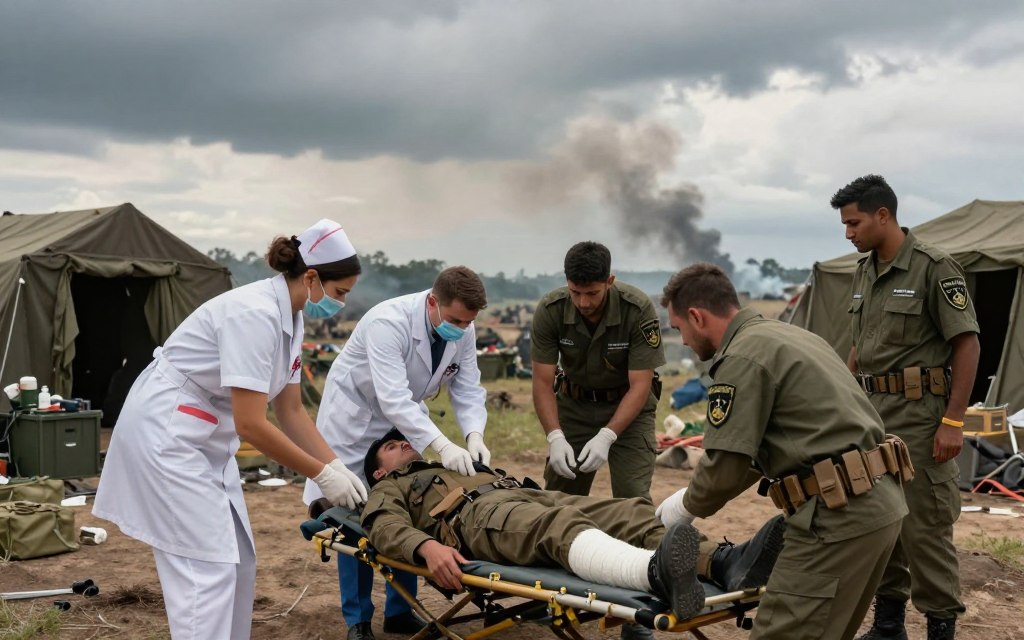
A wounded soldier far from a fully equipped hospital needs quick care, skilled staff, and reliable supplies. Medical science improved survival by addressing bleeding, injury, infection, and diagnosis.
Different treatments answered different needs. Blood transfusions helped replace lost blood, while skin grafts and trauma care addressed severe wounds.
Radiology helped doctors find injuries inside the body. During World War I, Marie Curie established 18 mobile and 200 stationary X-ray units for military use.
Alexander Fleming identified the antibacterial properties of Penicillium notatum mold in 1928. Commercial penicillin production began after World War II started.
Before the Normandy invasion in 1944, scientists prepared 2.3 million doses of penicillin. Mass production made the drug more widely available to treat bacterial infection.
Penicillin does not treat every wound or illness. A patient still needed timely care, trained personnel, and supplies delivered to the right place.
Medical teams depended on transport to move people, blood, equipment, and drugs. Those needs belonged to the wider logistics systems that sustain military operations.
Why Did Transport and Logistics Matter as Much as Weapons?
A capable unit may have to stop when its ammunition and fuel have not arrived. A weapon’s technical range is different from a force’s ability to keep it supplied.
Logistics covers the movement and care of people, equipment, and supplies. An ammunition shipment needs safe storage, while fuel needs suitable containers and medical supplies need careful handling.
Spare parts must reach mechanics who can repair broken equipment. Food, medicine, and tools also need routes that match their use and urgency.
Common logistical failure points include:
- Disrupted routes that block deliveries.
- Shortages of fuel or ammunition.
- Equipment breakdowns without needed parts.
- Supply plans that cannot keep pace with advancing troops.
Mechanization can help troops move farther and faster. It also raises demand for fuel, trained repair crews, and replacement parts.
A force may own advanced technology but lack the supplies to use it over time. The same problem applies to hospitals, aircraft, and communication systems.
Land routes and supply networks are only part of military movement; naval warfare brings distinct risks at sea.
How Did Naval Technology Reshape Sea Warfare?
A surface fleet can see ships above the water, but an underwater threat may approach unseen. Changes in ship design and submarine warfare forced navies to protect both fleets and sea routes.
Ironclad ships used iron armor to improve protection at sea. Their design changed the balance between ship defenses and the weapons aimed at them.
Submarines gave navies a way to attack surface vessels and shipping from below the waterline. Their hidden approach created danger for fleets and commercial supply routes.
Navies responded with detection efforts, escorts, and other countermeasures. A heavily protected ship could still face risk in waters where its crew could not easily detect an underwater enemy.
Technology alone did not settle naval combat. A study of naval innovation across three wars describes how tactics, strategy, trained crews, and enemy responses shape results.
The study of naval technology in three wars stresses that integration matters as much as a weapon’s design.
Sea power remained tied to the ability to find, defend, and supply ships. The Cold War extended military technology into nuclear competition and space.
How Did the Cold War Drive Nuclear, Computing, and Space Research?
During the Cold War, the United States and the Soviet Union sought to prevent nuclear attack while proving their technological reach. Their competition shaped military planning and helped drive research in rockets, satellites, and computing.
Deterrence means discouraging an attack by making its cost seem too high. Nuclear arsenals changed diplomacy and military planning because each side had to consider the risk of escalation.
Nuclear competition and deterrence
The arms race involved expanding nuclear forces and finding ways to detect threats. Its aim differed from many battlefield goals, yet the danger of war remained part of international tension.
Rockets, satellites, and computing
Sputnik 1 launched in 1957. The United States launched Juno 1 four months later, and the National Aeronautics and Space Act was approved in 1958.
Space work had military concerns and scientific aims, but the goals were not identical. Apollo 11 landed on the Moon on July 20, 1969, showing the reach of civilian and scientific space research.
| Area | Technology or event | Consequence |
|---|---|---|
| Nuclear competition | Expanding nuclear arsenals | Changed deterrence and international tension |
| Space competition | Sputnik 1 and the U.S. response | Accelerated government-backed space programs |
| Human spaceflight | Apollo 11 | Demonstrated the civilian and scientific reach of space research |
Computing and long-range communication supported many strategic systems. Those Cold War developments led toward the precision weapons and information networks used in modern operations.
How Do Precision Weapons and Sensors Shape Modern Operations?
Many unguided rounds can cover an area, while a guided weapon can be directed toward a specific target. Precision-guided munitions depend on good information and judgment, not guidance alone.
Precision does not guarantee accuracy. A guided weapon still depends on reliable intelligence, correct target identification, and communication that reaches the people making decisions.
https://www.youtube.com/watch?v=YfsTXcINpKE
Guided weapons and accuracy
In 1991, the Gulf War showed precision weapons, surveillance, target acquisition, and command and control working together. Command and control means the systems and methods used to direct military forces.
A weapon can follow its guidance and still be used against the wrong target if the original information is poor. Civilian presence can make the choice harder, even when sensors work well.
Surveillance, data, and system integration
Surveillance sensors can include radar, cameras, or other tools. Command and control networks share information among units and help coordinate their actions.
| Capability | Information or system used | Operational effect |
|---|---|---|
| Guided munition | Guidance and target data | Directs fire toward an identified target |
| Surveillance sensor | Radar, camera, or other sensor input | Detects or tracks activity |
| Command-and-control network | Shared data and communications | Helps coordinate units and actions |
Deception, poor data, interference, and civilians near a target can complicate decisions. AI can process information and support decisions, but it raises further questions about human control.
How Does the Military Use Artificial Intelligence?
Software can sort a large flow of surveillance data so a human analyst can review priorities. Military AI can support analysis without choosing or attacking a target.
AI can help sort intelligence, find patterns in large data sets, plan logistics, and support command decisions. These tasks do not all involve weapons or lethal force.
AI for analysis and operational support
The timeline of AI in military settings runs from early research and computing toward today’s data-intensive applications. Each step relies on data, software, hardware, and people who can check results.
AI-assisted decisions differ from autonomous weapons. An autonomous weapon can select and engage targets without direct human action, raising added questions about control and responsibility.
Autonomous weapons and human control
The weaponization of AI includes more than autonomous attacks. It also includes ways to sort data, plan supply needs, or help commanders weigh options.
Any proposed system raises practical questions:
- What data does the system use?
- How do people detect errors?
- Who can intervene or stop the system?
- How is responsibility assigned after a failure?
Bias, unreliable inputs, spoofing, and unclear accountability all pose risks. Human control matters most when a system could cause lethal harm.
Present uses and safeguards are easier to assess than distant forecasts. Future warfare calls for care about what can, and cannot, be responsibly projected.
Which Wartime Technologies Became Part of Civilian Life?
A radar component helped lead to a familiar way to heat food. Military research and development can support civilian uses, but military origins do not explain every later invention.
Transfer can take several forms: direct conversion to a household product, adaptation for public services, or later work that makes equipment smaller and cheaper.
The cavity magnetron generated microwaves for radar. Commercial microwave ovens became increasingly available in the 1970s and 1980s.
Radar also moved into public services. By the 1950s, it was being used to track rainfall and storm systems, helping people observe weather.
ENIAC was completed in 1945 and released to the public in early 1946. It had military origins and became part of the history of computing.
ENIAC occupied 1,500 square feet, used 40 cabinets that stood nine feet tall, and cost $400,000. Its patent entered the public domain in the 1970s.
Those details show a different kind of transfer: later development can make computing equipment smaller and more affordable. A military origin does not mean every civilian use was designed for military work.
These examples show why claims about future military technology deserve careful thought. A system’s later civilian use may differ greatly from its original purpose.
What Might War Look Like in 2050?
No one can know the exact shape of warfare in 2050, but several forces are already shaping it. More connected sensors, uncrewed platforms, cyber operations, and AI-assisted analysis are plausible directions, not certainties.
Possibly, forces may share information faster and use more uncrewed aircraft or vehicles. Precision weapons may continue to develop, while cyber operations may target networks and services.
New tools will still depend on power, reliable networks, trained people, and steady supplies. Poor maintenance or a broken connection can limit a system that works well in a test.
AI may help with administration or analysis, but decisions to use lethal force carry different risks. Meaningful human accountability matters when a system can harm people.
Asked what secret weapons the United States has, the honest answer is that classified programs cannot be reliably confirmed from public information. Public disclosures differ from speculation about hidden capabilities.
Readers can judge claims about future war with four checks:
- Identifiable evidence supports the claim.
- The described capability is clear.
- The claim recognizes realistic limits.
- Confirmed facts are separated from projection.
These signs help separate a credible report from a dramatic guess. A system’s military value depends on how responsibly and effectively people use it.
Conclusion
Scientific knowledge changes warfare through the choices made by military institutions and society. Research can increase military capability and bring benefits to civilian life.
Technology alone does not guarantee success or make war safer. A new system can fail through poor training, weak supply, or careless decisions.
When evaluating a claim about new military technology, check what it can demonstrably do, what limits it has, and who remains accountable. That approach keeps both capability and consequence in view.


 By
By



 By
By